Newborn puppies should not be left alone at all during the first 2 to 3 weeks of life. They cannot regulate their own body temperature, need feeding every 2 to 3 hours, and can decline fast without human supervision. Even when their mother is present, someone should be checking in regularly.
Once puppies are older, the safe alone time increases with age. Under 10 weeks: no more than 1 hour. From 3 months onward, roughly 1 hour per month of age, up to a maximum of 6 to 8 hours.
Here is everything you need to know about leaving newborn puppies alone safely — when it is okay, when it is not, and what to do if their mother is not around.
Can newborn puppies be left alone, even with their mother?
Not really — at least not for the first few weeks.
A healthy mother dog will nurse, clean, and keep her pups warm. But that does not mean she handles everything. First-time mothers especially can be overwhelmed, distracted, or uncertain about what to do. Even experienced mothers can accidentally lie on a puppy or miss one that has stopped nursing.
The safest approach in the first 2 to 3 weeks is to check on the litter every 1 to 2 hours, even overnight if possible. You do not need to be hovering all day, but no one should be leaving the house for hours at a stretch.
If you are a first-time dog parent navigating this — you’re not overthinking it. Newborn puppy care really does require this level of attention.
How long can you leave a puppy alone by age?
Once puppies are past the newborn phase and growing well, the rules shift. Here is a general guide:
| Puppy age | Maximum time alone |
|---|---|
| 0 to 2 weeks (newborn) | No time alone — constant supervision |
| 3 to 8 weeks | 1 hour maximum |
| 10 to 12 weeks | 2 hours |
| 3 months | 3 hours |
| 4 months | 4 hours |
| 5 months | 5 hours |
| 6 months and older | 6 to 8 hours maximum |
The main limiting factor for older puppies is bladder control — they simply cannot hold it for long. But for newborns, it goes far beyond that. They are completely dependent on warmth, food, and stimulation for survival.
What if there is no mother dog?
If the mother is absent — because she passed away, rejected the litter, or is too unwell to nurse — you are now a full-time caregiver. This is demanding but very possible with the right setup.
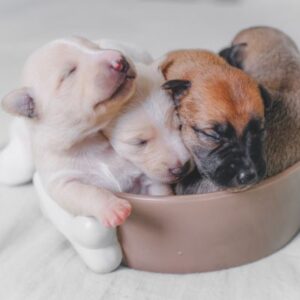
Your two most critical jobs are keeping them warm and feeding them on schedule.
For warmth: newborns need an ambient temperature of around 85 to 90 degrees F (29 to 32 degrees C) in their first week of life. Use a heating pad set on low, placed under one half of the nest so they can move away if they get too warm. Cover with a towel — direct heat contact can burn newborn skin.
For feeding: orphaned newborns need puppy milk replacer (available at most pet shops) every 2 hours during the day and at least every 4 hours overnight for the first week. Do not use cow’s milk — it causes digestive problems. Feed with a puppy feeding bottle or syringe.
You also need to stimulate elimination after each feed. Gently wipe their bottom and genital area with a warm, damp cloth — mother dogs do this with their tongue. Without this, newborns can develop a dangerous blockage.
If you have an orphaned litter, contact your vet immediately for guidance on feeding volumes, weight monitoring, and what to watch for. The AKC guide on raising newborn puppies is also a useful reference to have on hand.
A note for Indian dog parents specifically: if it is summer and your home is heavily air-conditioned, the cold draft can be as dangerous as the heat outside. Make sure the whelping box is placed away from direct AC airflow. You may also want to read about adopting a puppy in India.
What happens if you leave newborn puppies alone too long?
The risks escalate quickly with newborns. Here is what can happen:
- Hypothermia: Their bodies lose heat fast. A cold puppy will stop feeding, become lethargic, and deteriorate within hours.
- Hypoglycaemia: Missing even one feed can cause dangerous drops in blood sugar, especially in very small pups.
- Dehydration: Directly linked to missed feeds — newborns have almost no reserves.
- Accidental injury: The mother dog may accidentally lie on a puppy, especially in a crowded or small whelping box.
- Missed warning signs: A puppy that stops nursing or starts crying constantly needs attention. If no one is checking, it can go unnoticed until it is too late.
How to keep newborn puppies safe when you need to step away
You do not need to be glued to the whelping box every minute — but you do need a system.
Set a check-in schedule and stick to it. Every 1 to 2 hours during the day, and at least once or twice overnight in the first week. Check that every puppy is nursing, no one is pushed to the side, and the temperature in the box feels warm (not hot).
A pet camera is genuinely useful here — you can monitor from another room without disturbing the mother. Keep the camera angled on the nest, not the whole room.
If you have a job or commitments that require you to leave for several hours, arrange a trusted person to check in — a family member, neighbour, or friend. This is not optional for the first 2 to 3 weeks.
For longer absences — say, if you need dog boarding while travelling — note that most boarding services do not take neonatal litters. If you are in Ahmedabad, check dog boarding options in Ahmedabad early, and be upfront about the puppies’ ages.
Planning ahead also means getting your puppy vaccination schedule sorted early — your vet will give you a timeline for when the pups need their first shots, which is usually around 6 to 8 weeks.
When to call a vet
Do not wait and see if any of these signs appear. Call your vet the same day:
- A puppy has not nursed in 2 or more hours and is not latching
- Any puppy feels cold or limp when you pick them up
- Constant crying or whimpering that doesn’t stop after feeding
- The mother is ignoring or actively pushing away a puppy
- You notice a puppy that looks blue around the mouth or gums
- Rapid weight loss — puppies should gain weight steadily every day
The AKC’s guide on whelping and caring for newborn puppies has a useful weight-monitoring chart if you want to track progress. Healthy newborns typically double their birth weight in the first 7 to 10 days.
You can also learn how to check your puppy’s heartbeat at home — a useful skill in the early weeks.
Frequently asked questions
Can I leave my puppy alone overnight?
Not in the first 2 to 3 weeks. You should check on the litter at least once or twice overnight during this period. After 8 weeks, a healthy puppy can typically manage a full night if they have been properly fed and toileted before bed — but 2 to 4 hours alone during the day is usually the practical limit at that age.
What if the mother dog is with them?
The mother’s presence reduces (but does not eliminate) the need for supervision. You still need to check every 1 to 2 hours to make sure all puppies are nursing, none are being accidentally crushed, and the mother is coping well. First-time mothers need closer monitoring.
When can puppies be left alone for a full workday?
Most puppies are not ready to be alone for a full 8-hour workday until they are at least 6 months old — and even then, it depends on the individual dog. If you work full-time and have a young puppy, you need a plan: a dog sitter, a midday check-in, or a trusted person nearby.
How do you keep newborn puppies warm without their mother?
Use a heating pad set on low under one half of the whelping box, covered with a towel. The target temperature is around 85 to 90 degrees F (29 to 32 degrees C) for the first week. Make sure one side of the box is always cooler so puppies can move away from the heat if needed. Check regularly — overheating is just as dangerous as cold.
Can newborn puppies survive without their mother?
Yes, but it requires significant effort. They need to be fed every 2 hours with puppy milk replacer, kept at the right temperature, and have elimination manually stimulated after each feed. The mortality rate for orphaned neonates is higher than for mother-raised pups, which is why early vet involvement is important. Contact your vet immediately if the mother is unavailable.
How often do newborn puppies need to eat?
Every 2 to 3 hours in the first 2 weeks, day and night. After 2 to 3 weeks, as their eyes and ears open and they become more mobile, the interval can stretch slightly. Puppies nursing from their mother will self-regulate — your job is to make sure every pup in the litter gets access to a nipple and is gaining weight.
The bottom line
Newborn puppies are fragile in a way that most people underestimate until they are in it. The first 2 to 3 weeks require near-constant supervision — not because something will definitely go wrong, but because when it does go wrong, it goes wrong fast.
After that phase, things get easier steadily. Use the dog age calculator to track your puppy’s development and understand what to expect at each stage.
Set up a check-in schedule, get a pet camera, line up a backup person, and do not hesitate to call your vet if something feels off. You are doing something genuinely hard — and doing it right matters.